CONSCIOUS SYSTEMS — HOW TO BUILD CONSCIOUS SYSTEMS IN THE AI ERA
CATEGORY
BOOK
READING TIME
12 MINUTES + 516-PAGE BOOK
PUBLISHED / UPDATED
AUTHOR
HAN KAY
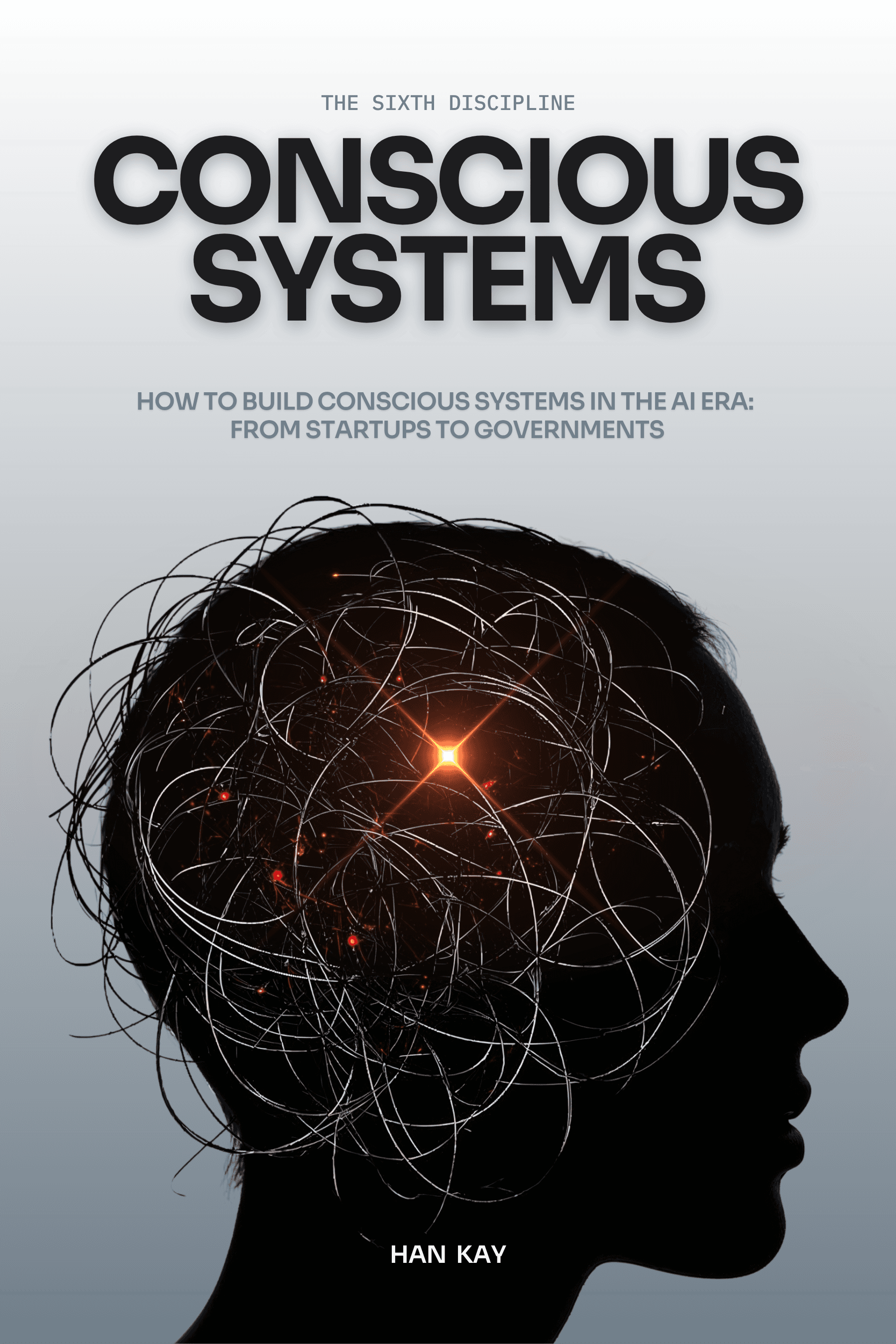
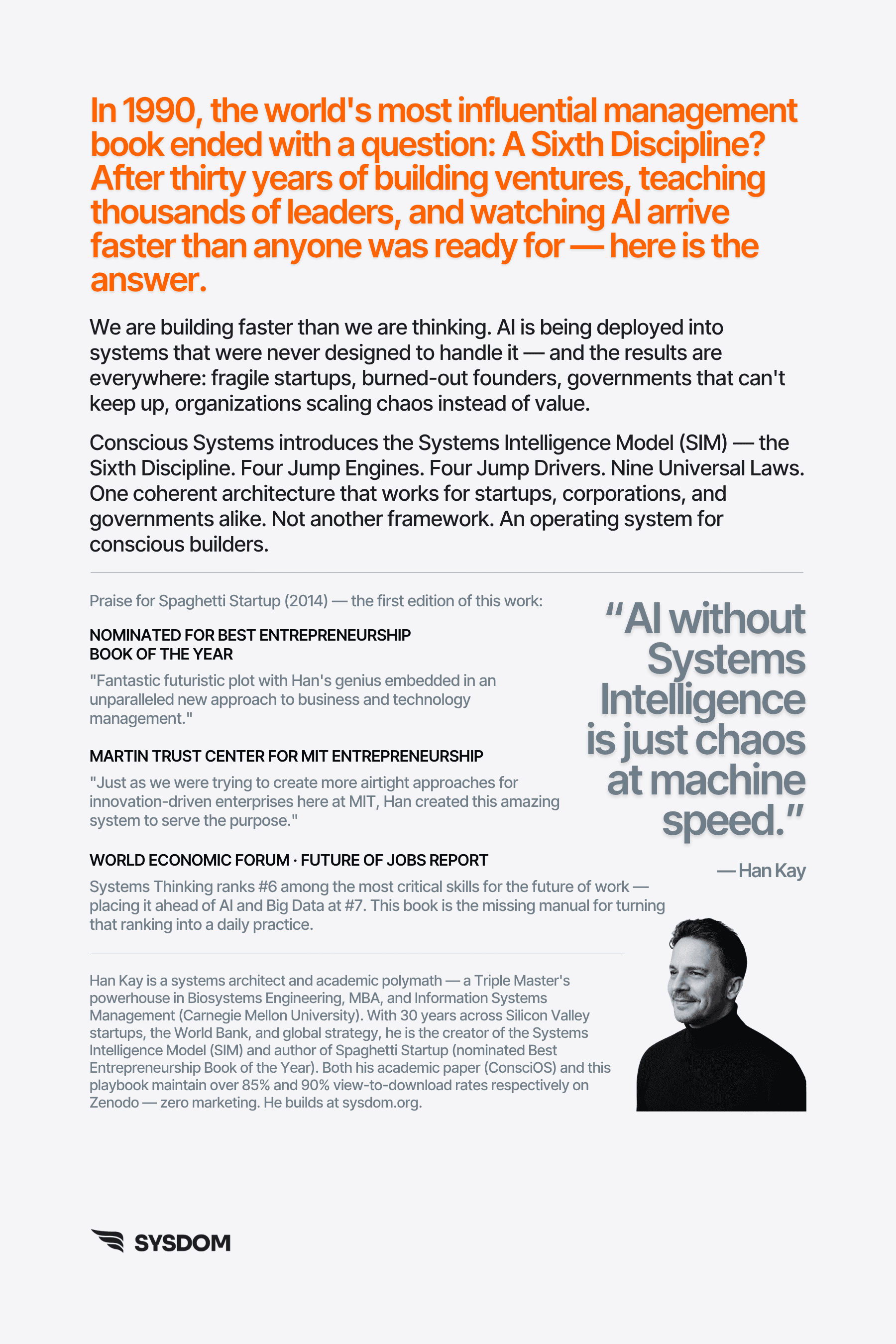
THE INFLECTION POINT WE CANNOT IGNORE
We are building faster than we are thinking. AI capability is advancing into healthcare, education, finance, governance, and venture creation while many of the systems beneath those fields are already buckling under complexity they were never designed to handle.
The central risk is not simply that machines become more capable. It is that human goals, incentives, blind spots, and institutional contradictions become executable at machine speed. The systems we encode now will determine whether intelligence serves human flourishing or scales dysfunction.
This is the premise of Conscious Systems: technology does not rescue a poorly designed system. It amplifies it.
THE MISSING SEQUENCE: HI-CONSCIOUSNESS → HI-SYSTEMS → HI-TECH
Most technology programs begin at the end of the sequence. They acquire tools, deploy models, and optimize outputs before clarifying what the whole system is for, what constraints govern it, and what consequences its feedback loops will produce.
Three failure modes follow. First, Hi-Consciousness is missing: builders operate from fear, extraction, ego, or unexamined assumptions rather than clear intent and awareness of stakeholders. Second, Hi-Systems is missing: even well-intentioned teams violate universal systems laws because they cannot see the structure producing the behavior. Third, the sequence is reversed: technology sets the direction rather than serving a consciously designed system.
The AI reflection principle follows directly: AI trained on collective human data and embedded in human institutions will amplify the consciousness and systems architecture we give it. Alignment therefore begins before the model.
CONSCIOUSNESS AS AN ENGINEERING CAPACITY
For thousands of years, contemplative traditions and wisdom lineages have treated consciousness as something that can be observed, trained, and transformed. We may not have a complete scientific account of what consciousness is, but we already know enough about how attention, mental models, identity, intention, and feedback shape action to treat consciousness as an operating capacity.
ConsciOS approaches that capacity with the discipline of Systems Engineering: define components, specify relationships, expose feedback, model failure modes, and make claims testable. The academic paper provides the formal architecture; Conscious Systems provides the practical path for builders.
THE CANONICAL 516-PAGE PLAYBOOK
Conscious Systems is not a handbook or a brief companion. It is the canonical Systems Intelligence book: 516 finished pages, 25 core chapters, extended implementation material, appendices, templates, checklists, laws, archetypes, and references. It is designed to function as a full operating library for conscious system builders.
PART I: THE COMPLETE CONCEPTUAL FOUNDATION
Part I is sufficient to begin. It establishes the system that runs all systems, the model that makes a venture legible, and the laws and recurring patterns that govern every complex adaptive system.
Understanding Consciousness examines mental models, awareness, purpose, attention, and the inner state from which systems are designed. The Systems Intelligence Model introduces four Jump Engines—Product/Service, Customer, Cash, and Skills—and four Jump Drivers—Innovation, Governance, Interaction, and Culture. Universal Systems Laws describe the physics that ventures cannot violate without predictable consequences. System Archetypes reveal recurring structures of success and failure. AI as Collective Intelligence shows how machines can amplify human intelligence without becoming a substitute for human judgment.
This is the foundation beneath every tactical method that follows.
FROM SPRINT ZERO TO OPERATING CADENCE
The remainder of the book turns the foundation into practice. Sprint Zero establishes the conditions for coherent work. The problem-discovery and value-proposition frameworks convert observation into a defined intervention. Dedicated chapters then design each of the four engines and each of the four drivers.
Later sections integrate the parts into one system: system integration, AI integration patterns, evolution patterns, quality-control systems, funding logic, and operating cadence. The appendices provide templates, checklists, a glossary, laws and archetypes references, leverage points, and source material.
The point is not to collect frameworks. It is to build one coherent architecture in which every component can be located, connected, tested, and improved.
THE SYSDOM TRIFECTA
The sequence matters because each layer governs the next.
Hi-Consciousness establishes self-awareness, purpose clarity, stakeholder awareness, and the ability to notice the assumptions driving action. Hi-Systems turns that clarity into structure through modeling, leverage-point identification, feedback-loop design, and alignment between parts and whole. Hi-Tech then applies automation, agents, and software through human-in-the-loop design, agent-in-the-loop escalation, guardrails, and coherence-preserving architecture.
New ventures can follow the sequence as an architected path. Existing organizations often have to retrofit all three layers simultaneously, but consciousness and systems design still govern what the technology should do.
THE SYSTEMS INTELLIGENCE MODEL
The SIM is the operational template at the center of the book. The four engines show where value is created, exchanged, accumulated, and renewed. The four drivers show how the engines coordinate, adapt, decide, communicate, and preserve a shared definition of good. Universal laws and archetypes sit at the center because they apply across every engine and every driver.
The model makes feedback visible. It lets a builder distinguish a Product/Service problem from a Customer constraint, a Cash symptom from a Skills bottleneck, and an engine failure from a breakdown in Governance, Interaction, Innovation, or Culture.
That distinction is what makes systems intelligence practical: the whole venture becomes one map, and the map becomes a basis for action.
BOOK AND PAPER: COMPLEMENTARY, NOT REDUNDANT
The ConsciOS paper and Conscious Systems serve different jobs. The paper develops the formal control architecture, nested controllers, coherence variables, hypotheses, evaluation proposals, governance considerations, and reproducible instrumentation. It is written for researchers, technical readers, and the AI-alignment community.
The book translates the underlying systems logic into accessible language, real-world cases, venture architecture, diagnostic models, and step-by-step implementation. It is written for founders, leaders, system designers, and conscious builders.
Paper equals theoretical and technical foundation. Book equals practical application and full operating playbook. Together they form the consciousness–systems–technology architecture.
FROM THE BOOK TO SYSDOM AI
Traditional business books usually end by asking the reader to assemble the operating system alone. Sysdom AI carries the model into product form. The agentic venture builder gives founders one living view of the venture, helps locate the active constraint, and turns approved work into bounded assignments for people and agents.
The product does not replace the book. It operationalizes it. The book develops systems intelligence; the product makes that intelligence usable during venture creation and operation.
START HERE
Read the full Conscious Systems book free on Maven.
Read Systems Intelligence Architecture on Zenodo.
Inspect the paper codebase on GitHub.
See how Sysdom works.
For a shorter practical entry:
AI Without SI: Why Your Projects Keep Stalling
Read Any Company in 20 Minutes.
The old systems are failing faster than we can patch them. Conscious system builders begin elsewhere: clarify the consciousness from which they build, design the system for human flourishing, and use technology as an amplifier rather than a master.
The world we want will not be given to us. It will be built by us.
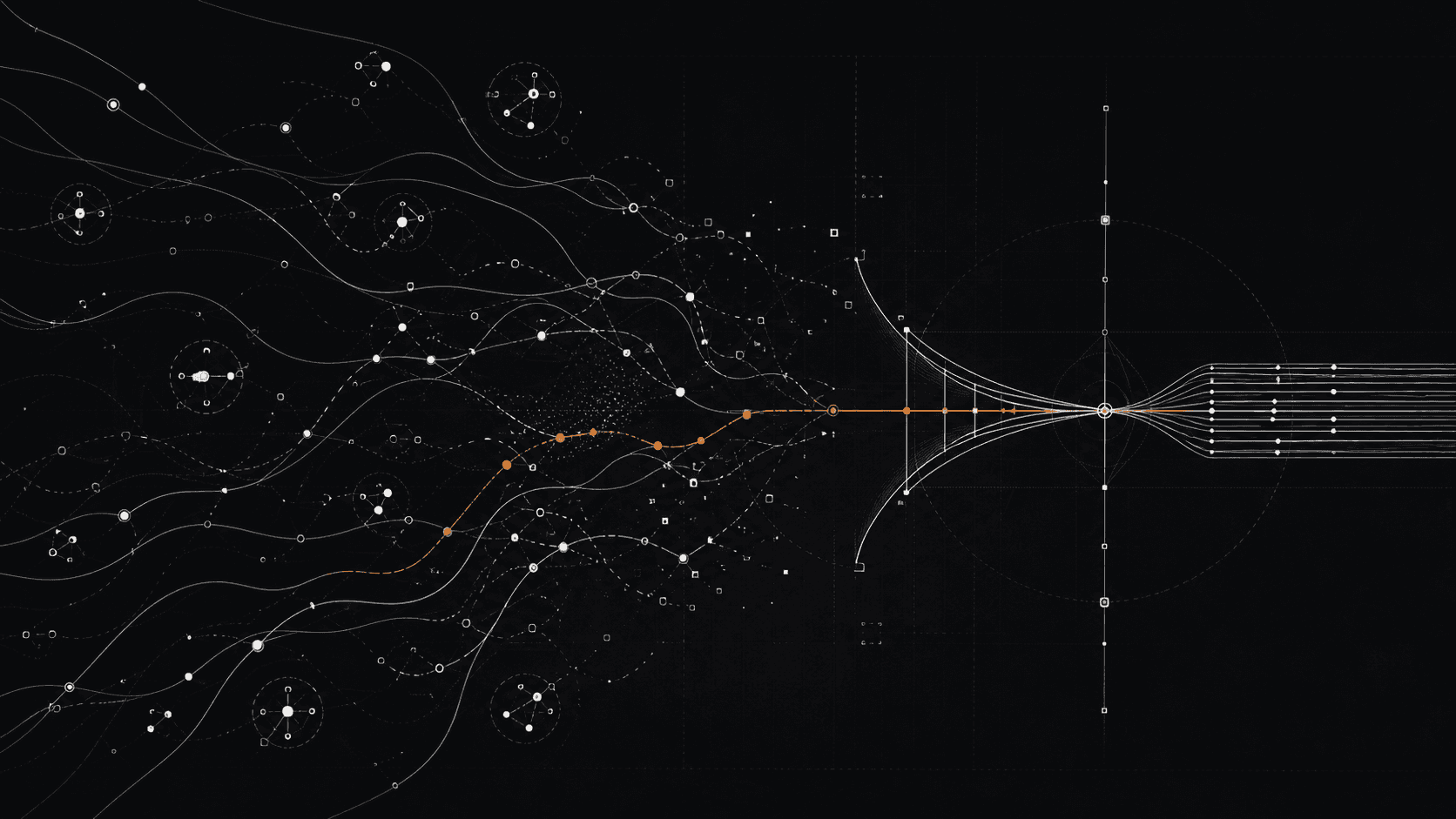

SEE THE WHOLE.
FIND THE CONSTRAINT.
MOVE WHAT MATTERS.
YOUR NEXT DECISION IS ALREADY OMITTING SOMETHING. SEE IT FIRST.
SYSDOM AI
SYSTEMS INTELLIGENT AGENTIC VENTURE BUILDER
SEE THE WHOLE. FIND THE CONSTRAINT. MOVE WHAT MATTERS.
BEFORE YOU ADD ANOTHER AGENT, FIND WHAT’S ACTUALLY STUCK.
